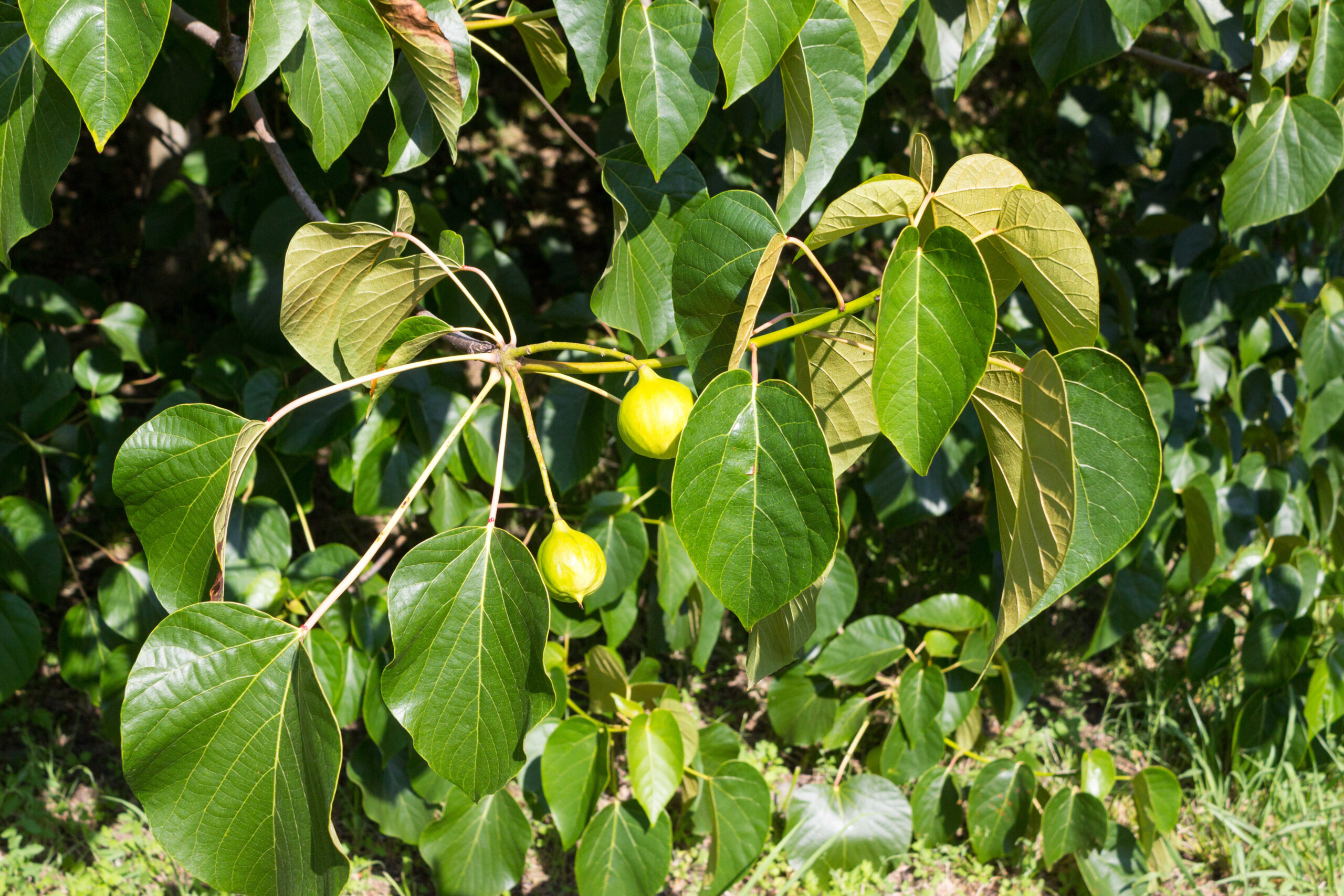
Shea butter comes from the kernel of the nut of the karité tree — Vitellaria paradoxa, which grows across a wide belt of West Africa and is harvested by hand, mostly by women, from wild trees. The tree starts bearing fruit at around fifteen years old.
Raw shea butter is ivory-colored and smells faintly of nuts. The white versions you find in shops are refined and deodorized.

Solid in the jar, soft on the skin
Like cocoa butter, shea is solid at room temperature and melts at body temperature. The difference is that shea is the softer of the two — it doesn’t snap, it softens and melts under your finger.
Its makeup is dominated by oleic and stearic acid, in almost equal parts. That is unusual, and it’s the reason for its typical behavior: oleic acid brings the softness and glide, stearic the firmness and stability. The two balance each other, which is why the butter sinks in instead of sitting on top as a layer.
That’s also the answer to the most common question about it: no, it isn’t greasy.
What it does in our products
In four of our soaps, shea gives the bar firmness and a soft feel after rinsing — the same job as cocoa butter, with a slightly lighter result.
In four of our body scrubs you feel it more, because there it stays a butter — it doesn’t go through saponification — and reaches your skin just as it is.
In all, it is in eight of our products.
We don’t overheat it
Shea butter is fussy about heat. Overheated and then cooled quickly, it crystallizes unevenly and turns grainy to the touch — it feels like fine sand that melts when you rub it. It hasn’t gone off, but it isn’t pleasant either.
That’s one more argument for the cold process: the butter goes into the recipe barely melted.
One warning worth saying out loud
If you’re allergic to latex, be careful with shea butter. The karité tree contains natural latex, and traces of it can remain in the butter. People with a latex allergy are at risk of a reaction.
It isn’t common, but it’s specific enough for us to write it down. If you’re in this group, tell us before you order and we’ll tell you which products are shea-free.
On the INCI list it appears as Butyrospermum Parkii Butter and is marked as an organic raw material. See all products with it →
As with any cosmetics: if your skin is reactive, test the product on your forearm before the first full use.